The Bluegrass vs. Fescue Ultimatum:
Surviving the Boise Micro-Climate
Precision Summary
Boise's 100°F summers and alkaline clay soils demand a specific biological response. Discover why the deep roots of modern Turf-Type Tall Fescue (TTTF) provide a massive evolutionary advantage over the shallow rhizomes of traditional Kentucky Bluegrass (KBG), and how it saves homeowners an average of $29.00/month.
The "Water Tax": Surviving Evapotranspiration
Irrigation management in Boise is not merely a task of supplementing rainfall but of managing a continuous, high-volume water demand. The "Water Tax" refers to the differential in water consumption required to keep various turf species green during the peak evapotranspiration period of June through August.
Because traditional Kentucky Bluegrass (KBG) has a shallow root system, it cannot sustain the plant through even minor moisture deficits in the upper soil. To keep KBG green and actively growing in Boise, a homeowner must apply water more frequently—often 3 to 4 times per week, demanding massive water volume.
Kentucky Bluegrass (KBG)
High volume required to offset surface evaporation and shallow root depth.
Turf-Type Tall Fescue (TTTF)
The Underground Advantage: Roots in Alkaline Clay
The fundamental difference in the performance of KBG and TTTF in the high desert lies in their respective hydraulic strategies. In the Boise micro-climate, the ability to exploit deep soil moisture is the primary determinant of drought avoidance.
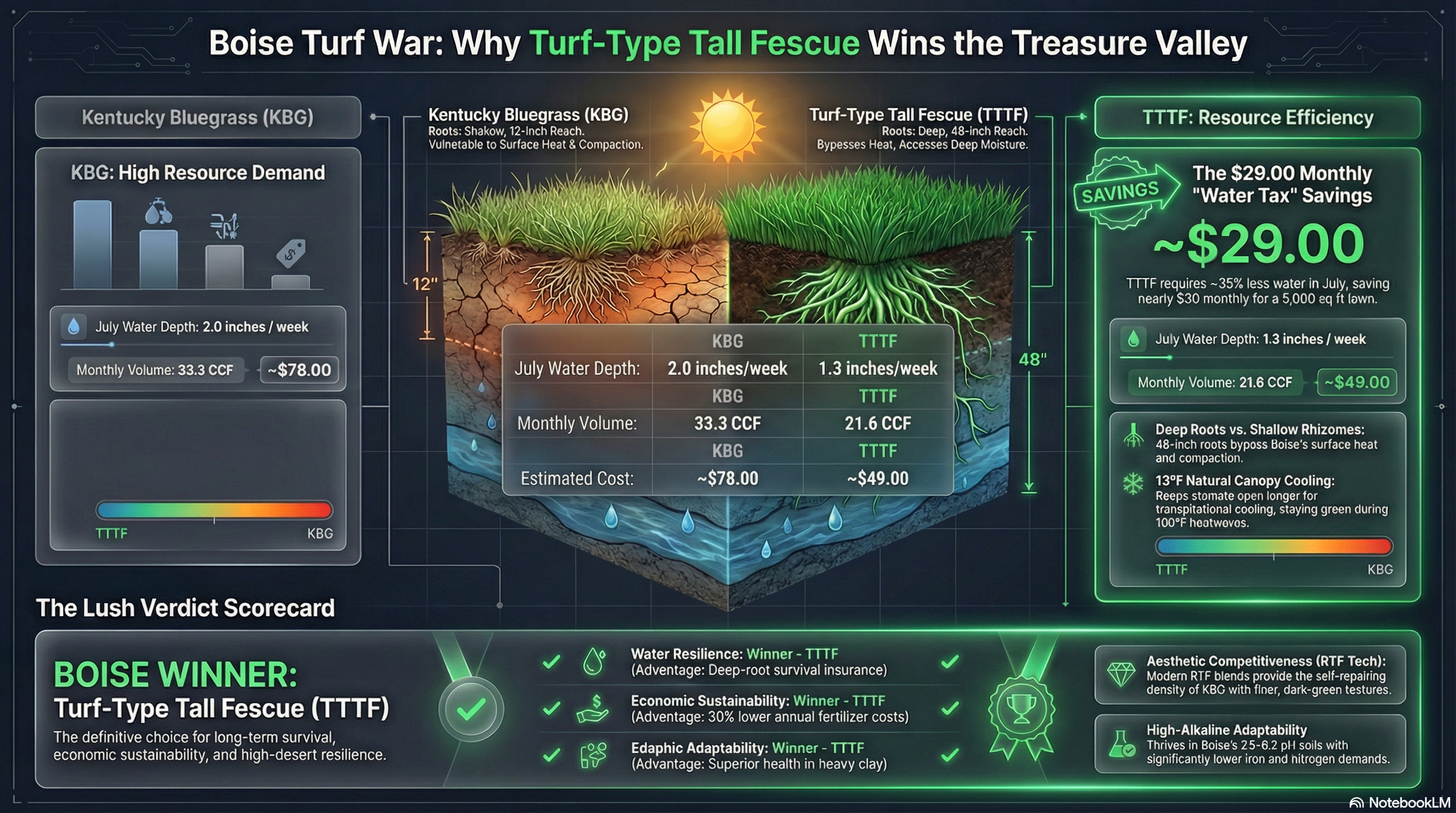
Figure 1: The Root Depth Dichotomy. TTTF taps into deep subterranean moisture entirely bypassing the severe 100°F surface heat experienced by KBG rhizomes.
Aesthetic vs. Resilience: Modern Genetics
Historically, Kentucky Bluegrass was the undisputed king of aesthetics in the Intermountain West due to its fine texture and self-repairing rhizomes, while Fescue was viewed as a coarse, clumpy pasture grass. However, 30 years of turfgrass breeding have fundamentally shifted this paradigm.
Modern TTTF cultivars possess significantly finer leaf blades that approach the aesthetic profile of KBG. Furthermore, Rhizomatous Tall Fescue (RTF) represents a genetic leap, producing true underground rhizomes that allow for lateral spread. This bridges the gap between fescue's deep-rooted durability and bluegrass's self-healing capabilities without the severe water penalty.
The Lush Verdict: The Smartest Investment
Based on the synthesis of climatological data, edaphic constraints, and economic modeling for the Treasure Valley, here is the definitive scorecard for the Boise micro-climate.
Water Scarcity Resilience
Deep-rooted architecture provides survival insurance against increasing drought frequencies.
Economic Sustainability
A ~35% reduction in summer water use yields significant annual savings on Veolia utility bills.
Aesthetic Competitiveness
RTF technology eliminates clumping and bridges the gap in side-by-side color and density comparisons.
Soil Adaptability
Handles alkaline, clay-heavy soils easily, showing drastically fewer signs of iron chlorosis than KBG.
Definitive Winner
Turf-Type Tall Fescue (TTTF)