The Fall-Only Mandate
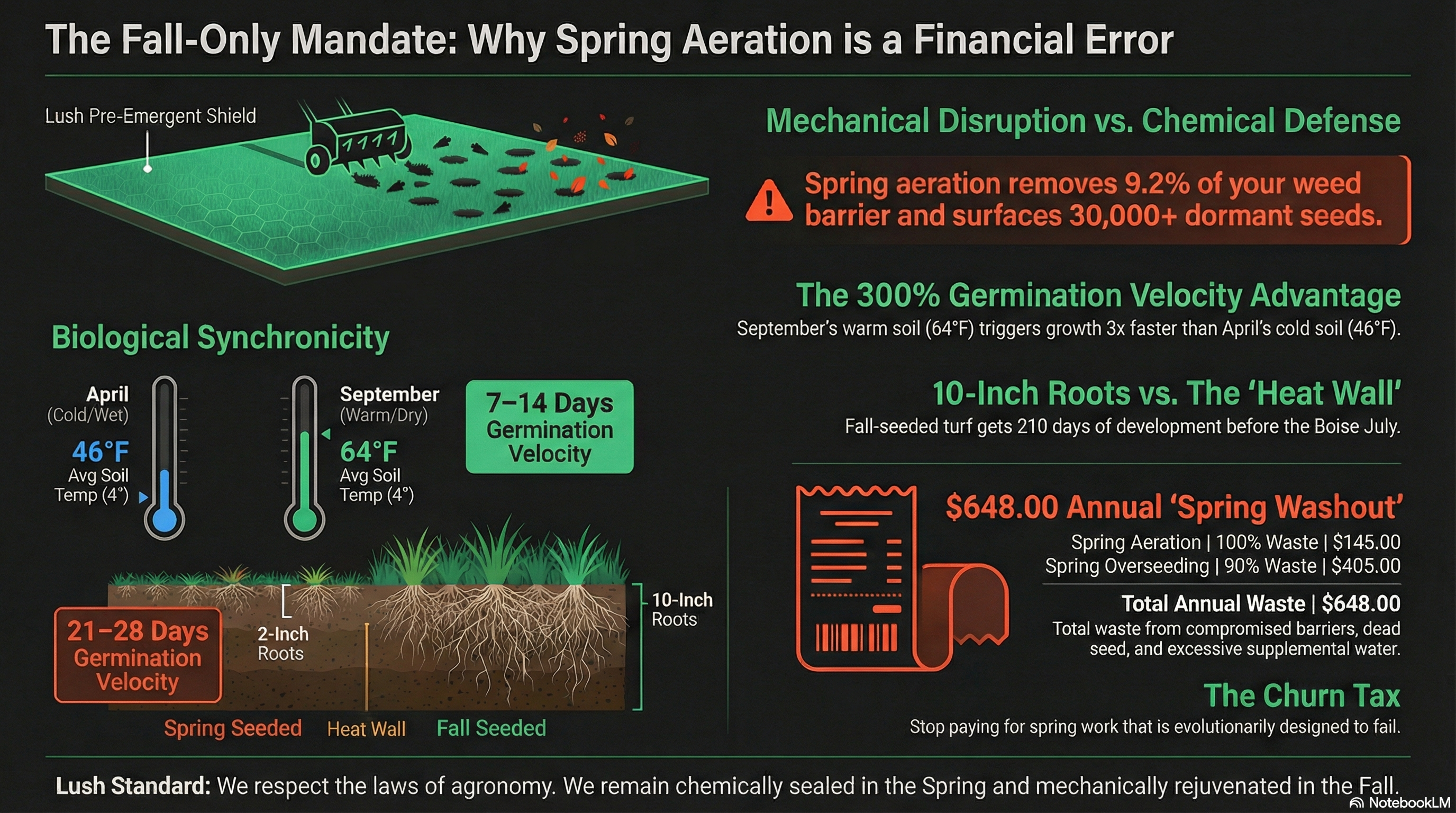
Stop paying to break your own lawn. Discover why spring aeration destroys your weed barrier and why the "9.2% Disruption" costs Boise homeowners $648 every year.
In the Treasure Valley, spring aeration isn't a service—it's a self-inflicted wound to your property’s defensive perimeter.
The Broken Shield (Financial Focus)
Aeration physically removes soil cores. When you aerate in the spring, you are removing up to 9.2% of the protective pre-emergent barrier you just paid to have applied.
Homeowners are paying for a chemical 'seal' to block crabgrass and spurge, and then paying a second time to physically punch 30,000 holes in it. It is the definition of financial churn.
The Thermal Trap (Biological)
Seed requires thermal energy to germinate. In April, Boise presents 'Cold Soil / Warming Air'—the exact opposite of what a seed needs to root deeply. Seed sits dormant, rotting in cold mud, or is quickly outcompeted by spring weeds.
In September, Boise provides 'Warm Soil / Cooling Air'. The soil has stored months of solar radiation, acting as a germination incubator, while the cooling air prevents canopy stress. Fall provides 300% faster germination velocity.
The Sidewall Smearing Trap
Boise sits on the Ada Series Clay profile. When this heavy clay is aerated in wet spring conditions, the tines create 'glazed' hole walls—a process known as sidewall smearing.
Instead of alleviating compaction, wet spring aeration creates 30,000 miniature clay pots in your lawn, structurally blocking root penetration and creating a shallow, heat-susceptible root system.
The 210-Day Head Start
A spring-seeded plant has approximately 60 days to develop a root system capable of surviving the 'Boise Heat Wall' in July. Biologically, this is an impossible task for Kentucky Bluegrass.
Fall seeding gives the plant 210 days of cool-season development before it ever faces a 100°F day. It survives the winter, establishes deep rhizomatic networks in early spring, and enters summer fully fortified.
The $648.00 Annual Washout
Standard lawn care companies push spring aeration because it fits their cash flow schedule, not your agronomic needs. The result is a cycle of financial loss for the homeowner.
When factoring in the compromised weed barrier, redundant labor, neutralized seed, and wasted water trying to force spring germination, the average Boise homeowner bleeds $648.00 into the ground every spring. The mandate is clear: Aerate and overseed aggressively, but only in exactly the right window.
The Spring Washout Audit
- Barrier Loss (9.2%) -$38.00
- Redundant Labor -$145.00
- Neutralized Seed -$405.00
- Wasted Irrigation -$60.00
- Total Annual Waste-$648.00
Thermal Velocity Chart
Competitive Phenology
- C4 Weeds (Crabgrass)55°F - 85°F
- C3 Turf (Bluegrass)65°F - 75°F
Spring seeding places juvenile turf directly into the optimal germination window for aggressive summer weeds.