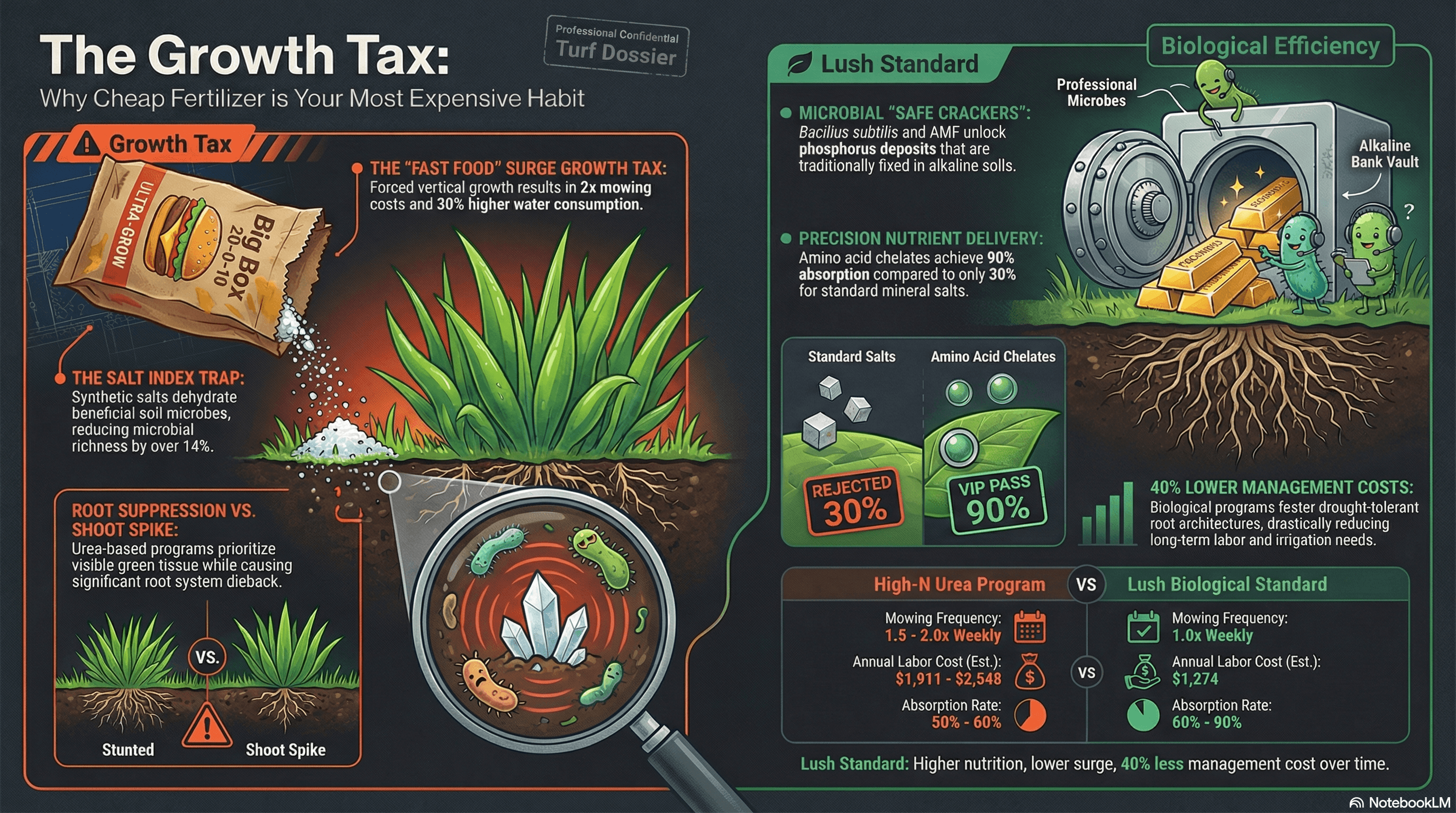
"Stop paying the Growth Tax. Discover why cheap urea is the most expensive habit in Boise and how our microbial Safe Crackers unlock your soil’s hidden gold."
The Growth Tax (Financial Focus)
Most homeowners believe that faster growth equals a healthier lawn. This is a fundamental agronomical error. When you apply standard, high-Nitrogen (N) urea from a big-box store, you are forcing the plant into a violent, vertical growth spike.
This creates Physiological Debt. The turf exhausts its carbohydrate reserves to push weak, watery top-growth, abandoning its root system entirely. The financial result? Your mowing frequency doubles, and the weak cellular structure requires 30% higher water consumption. You are literally paying an extra $637–$1,274 per season in labor and utilities just to manage the forced growth you paid to create.
The Growth Tax Audit
High-N Program (Standard)
- • Labor Cost: Extraneous mowing (~$2,548/yr)
- • Utility Cost: 30% water hike due to shallow roots
- • Result: High maintenance, low heat tolerance
The Lush Standard
- • Labor Cost: Controlled growth (~$1,274/yr)
- • Utility Cost: Optimized baseline watering
- • Result: Deep root resilience & dark color
Osmotic Dehydration (Biological)
Synthetic fertilizers are manufactured as highly concentrated salts. When applied to turf, they trigger the Salt Index Trap. The salt crystals draw moisture out of the surrounding environment through osmosis.
This doesn't just burn the grass blades; it chemically dehydrates and eradicates the beneficial soil biology. Regular application of synthetic salts reduces microbial richness by over 14% per season, stripping the soil of its natural nutrient-cycling factory and creating a permanent chemical dependency.
The Safe Crackers (Biological)
Boise soil is inherently rich in Phosphorus (P), but our high pH (7.5-8.5) actively binds it to Calcium, rendering it 100% molecularly unavailable to the turf. Most companies try to solve this by dumping more Phosphorus, which simply binds to more Calcium.
While not included in our standard maintenance programs, we highly recommend homeowners adopt the strategy of utilizing agronomical "Safe Crackers." By independently inoculating your soil with Bacillus subtilis and Arbuscular Mycorrhizal Fungi (AMF), you can bypass the chemistry problem with a biological solution. These microbes secrete specialized phosphatase enzymes that actively dissolve the Calcium bonds, unlocking the "Phosphorus Gold" the soil already owns.
The Microbiome Roster
The VIP Pass (Financial & Biological)
When nutrients must be supplemented, delivery mechanics matter more than volume. Standard salt fertilizers rely on passive diffusion—meaning only ~30% actually enters the plant, while 70% washes into the storm drain. Lush utilizes Amino Acid Chelates. Because amino acids are the building blocks of protein, the turf's cellular wall recognizes the molecule as "Food" rather than a synthetic chemical. The plant actively pulls the chelated payload inside (active transport), achieving a 90%+ absorption rate. We call this the biological VIP Pass.
Foliar Absorption Efficiency
Requires passive diffusion; highly inefficient.
Active transport; recognized as organic food.