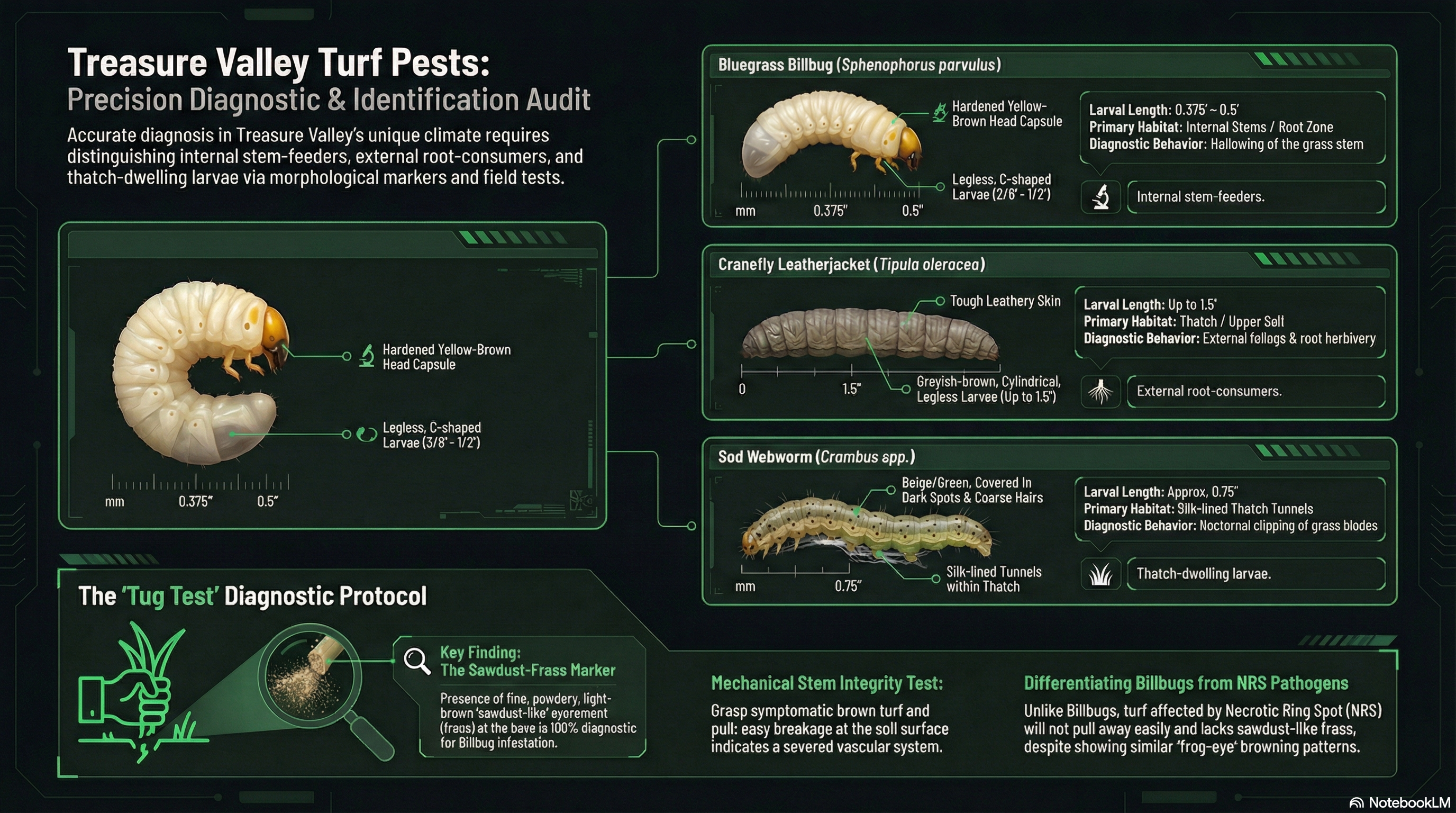
The Diagnostic Trap
Every July in the Treasure Valley, lawns suddenly develop massive brown, irregular patches. The immediate instinct for most homeowners is to dramatically increase irrigation run times, assuming extreme drought stress. This is the Diagnostic Trap.
Often, this is not a water issue—it is biological sheer. Bluegrass Billbug larvae are actively severing the turf canopy from its root system. No amount of water will save a plant with a severed vascular system. To accurately diagnose this, we utilize the "Tug Test" Protocol. If the brown stems break away with zero resistance and reveal sawdust-like frass (waste) at the crown, you have a Billbug infestation, not a dry spot.
Diagnostic Matrix
Biological (Billbugs)
- • Tug Test: Stems sheer off easily.
- • Sign: Sawdust-like frass at base.
- • Pattern: Rapid, irregular spreading.
Biological (Chinch Bugs)
- • Tug Test: Roots hold firm (unlike Billbugs).
- • Sign: Withered blades despite wet soil; visible 'piercing' at the crown.
- • Pattern: Rapidly expanding yellow patches in hottest, sunniest areas.
Pathological (NRS)
- • Tug Test: Roots hold firm against pull.
- • Sign: Blackened, rotted roots.
- • Pattern: Classic 'Frog-Eye' circular rings.
The Growing Concern: Hairy Chinch Bugs
While not part of Boise's "Original 3" primary turf pests, Chinch bugs represent a Climate-Driven Escalation in the Treasure Valley.
The Vascular Clog
Chinch bugs don't just eat the grass; they physically pierce the plant collar and inject a phytotoxin that clogs the vascular tissue. The plant is chemically blocked from absorbing moisture, leading to rapid decline.
The Financial Hook: Ghost Drought
Because the damage mimics severe dehydration, this is the #1 cause of "Ghost Drought" in the Treasure Valley. Homeowners routinely waste thousands of gallons of water trying to green up a lawn that cannot physically drink due to these toxins.
Species Differentiation
False Chinch Bug (Nysius raphanus)
The "Boise Nuisance"
- • Behavior: Swarms walls, foundations, and gardens in massive numbers.
- • Impact: Zero turf damage. Mostly a cosmetic annoyance.
Hairy Chinch Bug (Blissus hirtus)
The "Turf Killer"
- • Behavior: Targets Kentucky Bluegrass & Fescue specifically.
- • Impact: Widespread localized collapse; requires precision intervention.
The GDD Window (Ada County)
Preventative entomology is a game of mathematics, not calendar dates. At Lush, we utilize Growing Degree Days (GDD) based on a 50°F threshold to predict exact insect emergence.
For Bluegrass Billbugs in Ada County, adult emergence from overwintering sites mathematically triggers between 560-624 GDD. Applying traditional contact insecticides outside of this highly specific biological window is ineffective and environmentally irresponsible.
The Emerging Threat
Historically, Boise turf was primarily threatened by Billbugs and Webworms. However, modern over-irrigation practices have fueled the rise of the Common Crane Fly (Leatherjackets). These larvae thrive in perpetually soggy soils, aggressively feeding on root crowns in early spring.
Our primary cultural defense against Leatherjackets is the Labor Day Drought Stress method. By intentionally withholding water for 7-10 days in early September, we dry out the top inch of the soil profile, creating a hostile environment precisely when adult Crane Flies are attempting to lay eggs.
The Lifecycle Clock
The Soft Chemistry Standard
When intervention is mathematically required, Lush relies exclusively on Soft Chemistry. Legacy organophosphates indiscriminately sterilized the soil. We utilize advanced localized systemics like Chlorantraniliprole (Acelepryn), which targets the specific ryanodine receptors of chewing insects while bypassing predatory organisms entirely.
Crucially, this early-season Acelepryn protocol for Billbugs provides Synergistic Suppression for Chinch bug populations, stopping both threats simultaneously and preventing peak summer collapse.
Microbiome Synergy
Preserving the soil microbiome is critical. Soft chemistry allows beneficial predatory nematodes to survive and hunt surviving larvae. Furthermore, it protects Arbuscular Mycorrhizal Fungi (AMF) networks, which geometrically expand the root system's ability to scavenge water—providing essential stress tolerance to turf recovering from pest feeding.