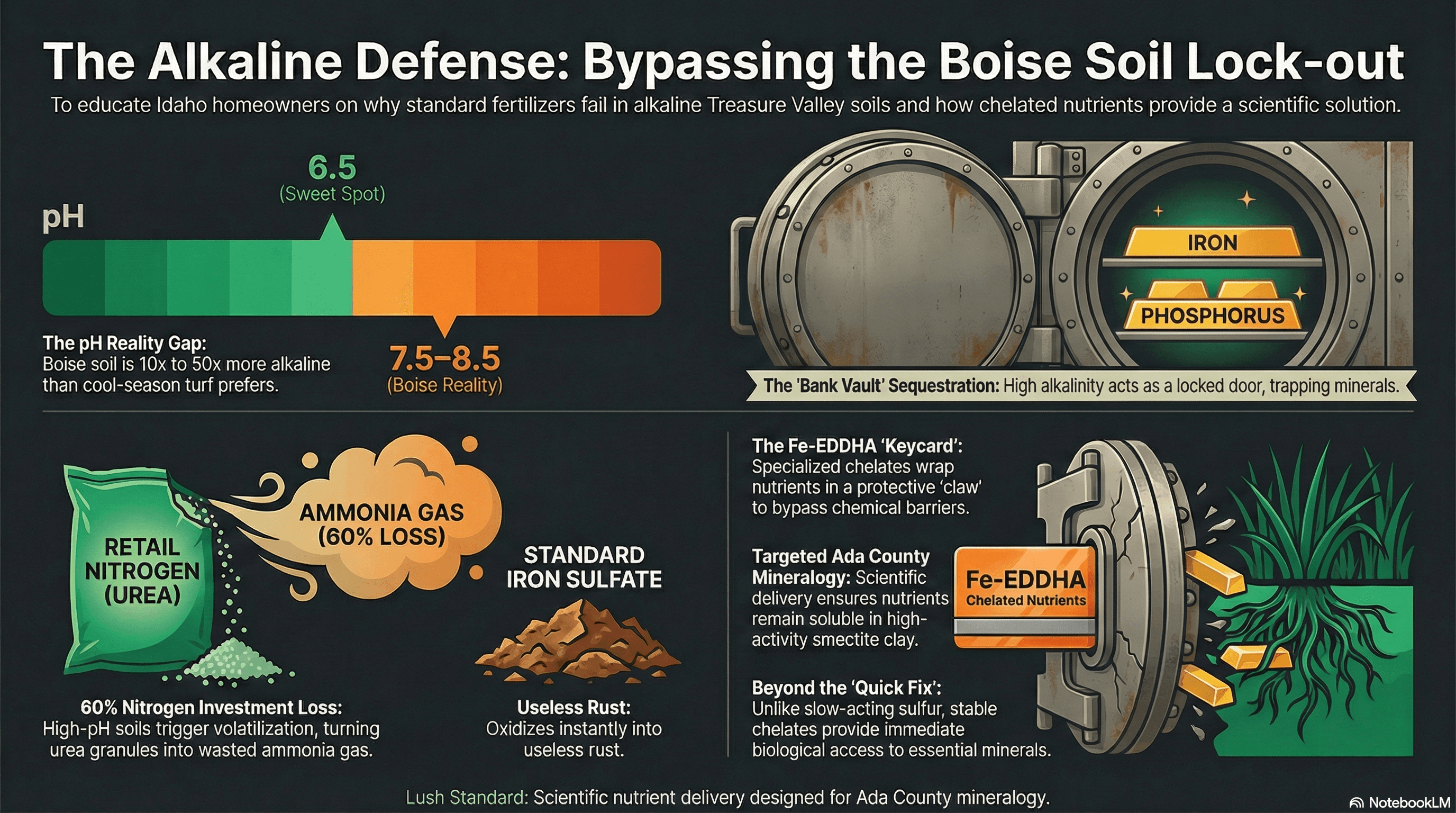
"In the high-alkaline environment of the Treasure Valley, your soil isn't just a growing medium—it's a chemical defense system that locks your nutrients away."
The Bank Vault Reality (Biological)
Boise soil is 10x to 50x more alkaline than the ideal environment turfgrass prefers. Typical cool-season grasses thrive in a pH of 6.5. In Ada and Canyon counties, our soil pH routinely hits 7.5 to 8.5. This intense alkalinity acts like a steel door, chemically binding essential micronutrients like Iron, Manganese, and Phosphorus directly into the soil structure, making them 100% unavailable to the plant roots—even if the soil is packed with them.
The pH Scale Lockout Zones
The $100 Gas Leak (Financial Focus)
When standard, agricultural-grade Urea fertilizer hits Boise's alkaline soil on a hot day, a violent chemical reaction occurs known as volatilization.
Because the pH is so high, the Nitrogen instantly converts into Ammonia Gas (NH3) rather than absorbing into the moisture profile. Up to 60% of the Nitrogen you paid for literally evaporates into thin air before the plant can consume a single ounce of it. This is why cheap fertilizer applications often show zero green-up in July.
The Iron Rust Trap (Financial Focus)
Iron is required for deep-green chlorophyll production. To fix yellowing lawns, generic companies dump cheap Iron Sulfate. However, turning bare Iron Sulfate into our high-pH, high-calcium soil causes it to rapidly oxidize. You are essentially paying for green grass, but chemically generating useless rust sediment.
The Efficiency Drain
Standard Fertilizer
- • Nitrogen: Up to 60% lost to gas.
- • Iron: Oxidizes to rust in hours.
- • Financial Yield: Poor ROI.
The Lush Standard
- • Labor Cost: Controlled growth (~$1,274/yr)
- • Utility Cost: Optimized baseline watering
- • Result: Deep root resilience & dark color
The Caliche Barrier
Throughout Ada County, heavy irrigation eventually pushes calcium down through the soil profile until it hits a stopping point. Over decades, this calcium cements together, forming Indurated Calcium Carbonate, locally known as Hardpan or Caliche. This impenetrable layer stops root penetration dead in its tracks and ruins soil drainage.
The Lush Keycard
We beat the bank vault by changing the locks. Instead of fighting the high pH, Lush utilizes Fe-EDDHA Chelated Nutrients.
A chelate (from the Greek word for 'Claw') is a specialized organic molecule that wraps around the raw mineral—protecting it from the surrounding alkaline soil. This chelated structure acts as an all-access keycard, allowing the nutrients to confidently bypass the alkaline door and feed the plant directly, remaining perfectly soluble and bio-available even in absurd pH ranges approaching 9.0.